 Business Central
 Sales
 Customer Engagement
 Customer Service
 Field Service
 Power BI
 Power Apps
 Power Pages
 Power Automate
 Microsoft Fabric
 Finance
 Supply Chain
 Project Operations
 More Microsoft expertise
Hire a Dynamics 365 Sales consultant when your business needs a clearer sales process, more reliable customer records or a better connection between sellers and management reporting. Start with the decisions the system must support, then define configuration, data, integration and adoption responsibilities. A functional consultant should turn those needs into usable working processes. Development or integration specialists can support specific technical gaps. The best hiring brief identifies business owners, measurable acceptance criteria and the level of continuing support required.
What to take from this guide
- Describe the selling process before choosing a consultant profile.
- Separate standard configuration from migration, development and integration responsibilities.
- Match the hiring model to backlog certainty and internal ownership.
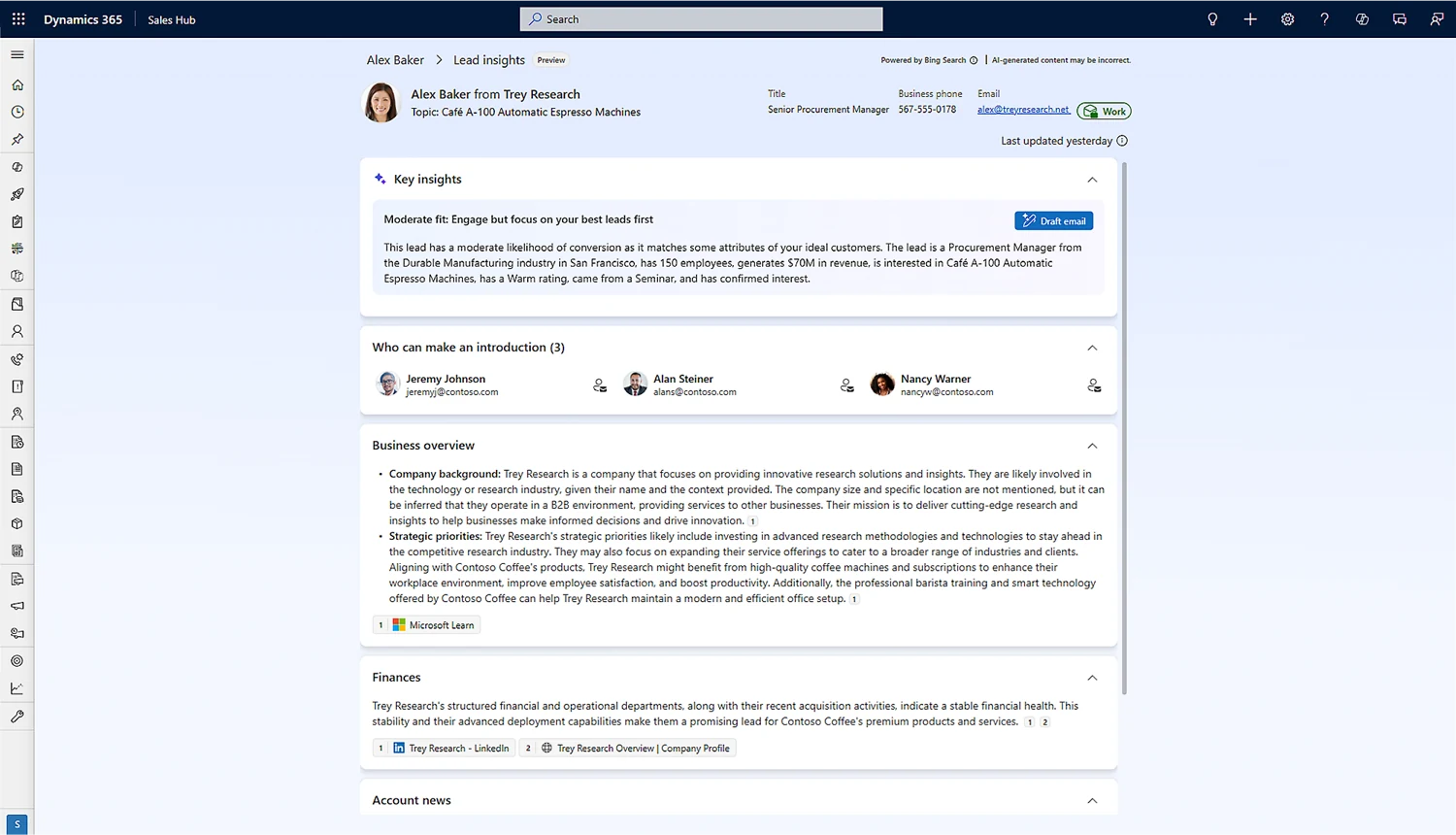
Start with the sales problem, not a feature list
A request to hire a Dynamics 365 Sales consultant often begins with complaints about incomplete pipelines, scattered customer information or spreadsheets outside CRM. Those symptoms need investigation. A pipeline can be unreliable because stages are unclear, because sellers lack time to update records, or because managers reward reporting behaviour that hides uncertainty. More fields alone will not resolve those causes.
Before interviews, select three recent deals: one successful, one lost and one stalled. Describe who handled them, what information was missing and which decisions arrived late. Ask prospective consultants to map those examples into a workable process. Microsoft describes Sales as supporting accounts, contacts and the progression from leads toward orders. Your discovery should establish which portions of that journey actually need attention and who will approve the revised working method.
Define qualification and opportunity stages clearly
A consultant should help the business distinguish an interested contact from a qualified commercial opportunity. In Microsoft’s documented sales process, lead qualification creates an opportunity. Your organisation still needs its own criteria for making that decision. For example, a hypothetical equipment supplier might require a confirmed application, likely purchase timing and an identified decision maker before a deal enters the active forecast.
Avoid stages named only after internal actions such as proposal sent. A proposal can remain unanswered for months. A stronger definition explains what has changed in the customer’s buying position, what evidence is required and who owns the next action. Ask for written entry and exit criteria, sensible exceptions and examples for different deal types. The consultant’s quality becomes visible when experienced sellers can interpret the same opportunity consistently without an administrator explaining every field.
Choose a functional consultant, developer or architect
A functional consultant is appropriate when the main work concerns processes, forms, views, sales terminology, working practices and business acceptance. A developer becomes important when agreed requirements need custom logic or specialised interfaces. An architect is useful when multiple applications, business units or integration patterns require coordinated decisions. These responsibilities may overlap in an experienced profile, but overlap should be demonstrated rather than assumed.
Review Dynamics 365 Sales functional consultant resources against a written scope. If the initiative includes significant technical design, compare that brief with Dynamics 365 Sales solution architect expertise. Ask each candidate to identify work they would escalate. Someone who explains their limits and dependencies can be easier to manage than a generalist who agrees to everything. Allocate a business decision maker alongside the external resource; technical competence cannot replace commercial ownership.
Turn reporting requirements into agreed definitions
Sales reports become contentious when people use the same word for different things. Revenue may mean an opportunity estimate, an accepted order, a shipped product or a recognised financial amount. The resource brief should state which measure belongs in each review. Agree how close dates, probability, currency and ownership affect a report before anyone designs a dashboard.
Request a reporting dictionary with a small number of important measures, their source records and their intended users. Test it against the three deals collected during discovery. A sales manager should be able to explain why a deal appears in a particular bucket and what action that should trigger. Include historical expectations: a report showing today’s records is different from a report reconstructing last month’s forecast. Where analytical needs exceed operational views, define a separate reporting dependency instead of quietly expanding the CRM consultant’s assignment.
Need this expertise in your team?
Start with the workstream, expected outcome and working hours.
Make adoption part of the consultant’s delivery
Training is more effective when it reflects real work. Sellers need to know how to prepare for a customer conversation, record a meaningful update and recognise the next step. Managers need to run meetings from the agreed records. Administrators need to understand which changes are safe and which should enter a controlled backlog. A single generic demonstration does not cover those audiences.
Ask the consultant to prepare short task-based exercises, a glossary and examples of good records. Pilot the process with a mixed group that includes a confident seller, a reluctant user and a manager. Record difficulties without treating every request as an automatic customisation. Some problems require clearer ownership or fewer mandatory fields. Measure adoption through completed business tasks and data usefulness, rather than login counts alone. This makes the engagement relevant to revenue operations as well as application administration.
Compare Hourly Model, Project Based and Dedicated Resource
The Hourly Model suits targeted work such as reviewing pipeline stages, correcting a defined configuration issue or advising an internal administrator. Establish an initial investigation allowance, a prioritised task list and a point at which the consultant must explain further effort. It is particularly useful when the root cause remains uncertain.
Project Based hiring fits a bounded Sales implementation or improvement package with known business owners, available data and agreed acceptance scenarios. Define exclusions, change handling and the customer’s responsibilities before fixing the delivery boundary. A Dedicated Resource suits an ongoing rollout, a partner delivery team or a continuing CRM improvement backlog. The resource needs a product owner, regular priorities and access to timely decisions. Dedicated capacity does not by itself guarantee a finished project; project delivery still depends on scope, approvals, testing and the surrounding team.
| Model | Best fit | Buyer responsibility |
|---|---|---|
| Hourly Model | Targeted process or configuration review | Prioritise tasks and approve investigation |
| Project Based | Agreed rollout or improvement package | Approve scope and acceptance |
| Dedicated Resource | Continuing CRM backlog | Provide a product owner |
Assess capability with a realistic working discussion
Use an anonymised scenario rather than a memory test. For example, a hypothetical distributor has duplicate accounts, inconsistent opportunity stages and a weekly forecast prepared manually. Ask the candidate to propose a first-week assessment, explain which users they would interview and identify what should not be changed immediately. Good answers distinguish symptoms, evidence and assumptions.
Request examples of deliverables they personally produced, with confidential details removed: a process map, configuration decision log, test scenario or adoption guide. Discuss how they handled a disagreement between sales leadership and daily users. If certification matters to your selection, request the individual’s verifiable credential and check its status; a badge alone does not establish recent delivery experience. Agree who will perform technical review when integration or custom development falls outside the consultant’s strongest area. This produces a fairer comparison than years of experience alone.
Plan remote delivery across regional sales teams
A business hiring from India for teams in the United States, Canada or Europe should define overlap around actual sales operations. A morning pipeline meeting in one region may occur late in the consultant’s day. Agree a practical meeting window, response expectations and a written route for decisions outside that window. Distinguish planned availability from emergency support.
For the United Kingdom, Germany, the Netherlands, Denmark, France or Mexico, establish which language is required for workshops, documentation and user training. Do not assume that a consultant who configures English-language screens can train every regional team. Use representative regional scenarios for currencies, date conventions, territories and reporting expectations. Country names in a resource brief should describe concrete needs, not substitute for them. Keep a shared decision log so regional teams can see why a common process includes particular local exceptions.
When the brief includes configuration decisions that affect several systems, a Dynamics 365 Sales technical consultant can assess those dependencies alongside the functional owner. For a continuing improvement backlog, define the responsibilities of a Sales support consultant, including issue triage and communication with business users.
Prepare a brief that produces useful profiles
A useful enquiry explains the current application, the problem, the affected users and the desired change. Include whether this is a new implementation, a rescue engagement or ongoing improvement. List connected systems, migration needs, available internal roles and the expected workshop language. State what the first meaningful outcome would look like rather than asking for someone who knows every feature.
Before shortlisting, confirm these five points: who approves the process; who supplies and cleans customer data; who owns integrations; who signs off user testing; and who supports the solution after handover. Then compare candidates against that exact assignment. If application connectivity is a major part of the brief, consider Dynamics 365 Sales integration specialists alongside functional support. This keeps the consultant’s remit realistic while giving your team a clear route for technical questions and future changes.
- Named sales process approver
- Representative deals for discovery
- Clear integration ownership
- User-testing availability
Before your next hiring conversation.
Can one consultant handle configuration and sales adoption?+
Yes, when the individual has demonstrated both process consulting and user-facing delivery experience. Ask for examples of workshops, configuration decisions and training materials from their own work. For a larger rollout, regional trainers or internal champions may still be necessary. Define adoption activities explicitly so they are not treated as optional work after configuration is complete.
Which hiring model works for improving an existing Sales environment?+
Start with the uncertainty. Hourly support is useful for diagnosis and a limited improvement list. A Project Based engagement becomes suitable once the scope and acceptance examples are clear. A Dedicated Resource makes sense when ongoing releases, multiple business units or a sustained backlog require regular capacity and a product owner can keep that capacity focused.
What should we share before requesting a Dynamics 365 Sales profile?+
Provide the business problem, current Sales application, approximate user groups, connected systems and expected responsibilities. Include workshop language, overlap hours and the person who approves decisions. An anonymised example of a difficult deal is useful. Avoid sending live customer exports at the enquiry stage; process descriptions normally provide enough information for an initial role match.
Your next step
To discuss a Dynamics 365 Sales resource, share your current sales process, the three most important problems and the first outcome you want the consultant to achieve. Include integrations, decision owners and working-hour expectations. Sirius Dynamics can use that brief to discuss relevant profiles, a discovery call or a requirements review. Choose the hiring model after the responsibilities are clear, so the engagement supports useful sales decisions as well as working screens.
Check the product detail.
Official references for the product and delivery considerations discussed here. The hiring recommendations and illustrative scenarios are Sirius Dynamics editorial guidance.
- Welcome to Dynamics 365 Sales ↗Supports the account, contact and lead-to-order product context; hiring recommendations are editorial guidance.
- Understand the sales process ↗Supports the limited explanation of lead qualification and opportunity progression.